Tennis is an odd sport at times, where tournaments can often limit access and operate as a closed shop to the media.
It might seem biased, but to me, this comes across as counterproductive and only sacrifices the free opportunity to put more eyes on their event.
The Almaty Open could not have been more refreshing in its approach over the last week, as we were afforded the opportunity to speak with Dias Doskarayev, the Vice-President of the Kazakhstan Tennis Federation, ahead of its flagship event in the country.
Although only an ATP 250 event at the back end of the season, this has attracted some of the world’s biggest names in recent years, and once again boasted a strong player list this time around as well.
Over the past few days, Tennishead asked Daniil Medvedev for his thoughts on Alexander Zverev becoming the world number one, and Stefanos Tsitsipas about Gael Monfils’ retirement.
And then, in another exclusive, we gained crucial insight into the future of the Almaty Open in our chat with Doskarayev.
Kazakhstan tennis chief discusses his future plans for the Almaty Open
Unsurprisingly, when it came to his aspirations for the future, Doskarayev outlined how a strong player list remains the priority.
After all, attracting the biggest names represents a glowing endorsement for the tournament, attracts more fans, and increases the stature of the event.
He admitted: “Our main goal is to assemble an interesting and competitive field every year, and we would like to continue attracting as many strong and exciting tennis players as possible to the tournament, including young players who could become new stars of world tennis in the future.
“At the same time, we are looking to the tournament’s long-term development, with one of our key ambitions being to upgrade the Almaty Open to ATP 500 status.”
It is no mean feat to achieve such an upgrade, but the Almaty Open is certainly going about it the right way.
Although an indoor event, the tournament is famed for its phenomenal surroundings, with the city boasting a stunning urban skyline framed by towering snow-capped peaks of the Trans-Ili Alatau mountain range.
Doskarayev actually then revealed that he is already in dialogue with the ATP to make this dream a reality, but admitted there will be hurdles to overcome: “We are in discussions with the ATP and exploring options for securing the necessary licence. However, opportunities remain limited due to the ATP’s calendar restructuring, with some licences already allocated. Nevertheless, we remain committed to pursuing this goal in the coming years.
“In the meantime, we are focused on ensuring that the tournament is fully prepared for this step. The Almaty Open already exceeds the minimum ATP 250 requirements in infrastructure, technical provision, player conditions, logistics and spectator experience. Our aim is to be among the leading events in the ATP 500 category from the outset.”
The 2026 Almaty Open’s strong roster and history of great players
Doskarayev’s ambition is hugely admirable, but it is far from delusional.
After all, when asked to name a dream player he would love to welcome to Almaty, he instead opted to list the many superstars who have already graced the courts. These dreams have already become a reality for him.
He added: “In 2022 we had Carlos Alcaraz, Novak Djokovic, Stefanos Tsitsipas, Andrey Rublev, and Daniil Medvedev. Around seven players from the world top 10 took part in the tournament that year.
“Karen Khachanov, Flavio Cobolli, and Luciano Darderi have also come to our tournament. It is very important to us that as many Kazakhstani players as possible compete in the Almaty Open. Our main goal is to assemble an interesting and competitive field every year.”
Alexander Bublik was, of course, the standout draw for the home fans.
Sadly, the Kazakhstani superstar was forced to retire from his semi-final match with the eventual champion Medvedev, and he exited the Centre Court to a great reception.
Doskarayev finished by discussing this year’s player list, which was once again laden with world-class talent.
Speaking before the tournament had begun, he claimed: ”As for the most exciting players in the current tournament, it is also difficult to single out just one. For example, Adrian Mannarino, who comes to the Almaty Open regularly, always plays well here and enjoys our courts.”
The Vice President also mentioned Tsitsipas, whose level has only been improving, as well as singling out Rei Sakamoto as a ‘very interesting and promising young player’.
Naturally, Doskarayev was most excited to see Bublik, noting: “Of course, Alexander Bublik remains one of the most exciting entrants. The Kazakhstani public adores him, and fans have been waiting a very long time for the chance to see him on the courts in Almaty.”
A trip to Almaty for the ATP 250 that is aiming to move up a category. Twenty years ago the country had neither facilities nor organisation. Today, thanks to investment from billionaire Utemuratov, Kazakhstan is establishing itself as an emerging power in the sport.
From our correspondent Marco Iaria, 25 October, 07:44, Almaty (Kazakhstan)
Almaty greets you gently. It is no coincidence that this is the city of apples: alma means apple in Kazakh. These days the country is proudly celebrating Republic Day. The number 25 is everywhere, a reminder that on 25 October 1990 Kazakhstan adopted its Declaration of State Sovereignty, a crucial step towards independence from the Soviet Union, proclaimed a year later.
This is a land in between, a bridge between the Far East and the West. You sense it in the mix of faces, voices and cultures, on the streets or in the great bazaar, wrapped in the scent of spices. Almaty is also the economic and financial heart of Kazakhstan, the largest economy in Central Asia, with GDP of USD 306 billion in 2025, up 6.5%. This wealth is driven mainly by natural resources. Oil is the country’s engine, with production of almost 100 million tonnes a year. The hydrocarbon sector accounts for 15% of GDP and more than half of exports. While the major fields are concentrated mainly in the western regions, it is here, in the former capital, that the main financial and commercial hub is located, with its banks, large companies and real estate investment. It is a metropolis in constant expansion, growing, changing and spreading towards the steppe. To see this, you only need to take the road to the Almaty Arena on the western outskirts of the city.
Since 2007: the turning point with Bulat Utemuratov
You leave behind the buildings with their modernist geometry, a legacy of Soviet urban planning, the wide tree-lined avenues, the neat pavements and the immaculate parks. When the sky is clear, the snow-capped peaks of the Tian Shan stand out in the background. As you move away from the centre, the landscape changes. Buildings thin out, distances grow and new residential complexes alternate with empty plots. Then, almost suddenly, the Almaty Arena appears: an imposing glass-and-metal structure that has hosted the ATP 250 tournament since 2024, with capacity for 7,000 spectators. The ambition is to make it one of the leading sporting events for all of Central Asia and the Commonwealth of Independent States, also taking advantage of its strategic slot in the tennis calendar, after the swing through China and Japan and before the final stretch in Europe. Money is not a problem. Bulat Utemuratov, the head of Kazakh tennis and Vice-President of World Tennis (the international federation), is credited by Forbes with a personal fortune of USD 5.4 billion and has already invested USD 250 million in building the country’s tennis movement from scratch. Nor is there any shortage of passion, judging by the football-style support that greets every shot of local hero and showman Alexander Bublik. Kazakhstan currently has around 18,000 children under 10, 2,700 junior players and 9,500 amateur players (men and women) who compete and take part in tournaments, more than 43,000 regular players in total.
USD 250 million: Bulat Utemuratov’s investment in the development of tennis in Kazakhstan
In recent years the Kazakhstan Federation, which has 580 qualified coaches, has run a programme to increase participation in the sport. As a result, more than 36,000 children now play tennis in kindergartens and schools as part of the regular curriculum. The Federation has also worked to make tennis affordable for families by subsidising lessons: children can train up to six days a week for between USD 40 and 120 a month. Kazakhstan has 39 tennis centres with a total of 391 clay and hard courts, 232 outdoor and 159 indoor. A programme has been approved to build another 15 tennis centres in the country’s main regions by 2035. This will add 160 courts for training and for hosting international tournaments, bringing the total to 551. But building courts is not enough. The Federation has also invested in organising youth and professional tournaments across the country, giving local talent the chance to compete against foreign opponents without constantly bearing the cost of travelling abroad. If these seem like dry figures, consider that before Utemuratov became Federation president in 2007, the whole of Kazakhstan had only 60 courts and no more than 1,000 registered players.
Stars from Russia and young talent
“Tennis in Kazakhstan is experiencing a real boom,” Yuriy Polskiy, Vice-President of the Kazakhstan Federation and head of the Asian Tennis Federation, tells us. “It is driven largely by the extraordinary results of our best athletes. Elena Rybakina has won three Grand Slam titles and become the first Kazakh player to reach world number one, Alexander Bublik has broken into the men’s top 10 and Anna Danilina reached the doubles final at the Australian Open. These results have made tennis one of the most followed sports in the country, and we are seeing a significant rise in interest among children. More and more families want to bring their children to the courts because they have concrete examples of how a Kazakh athlete can reach the very top of the sport. Elena and Alexander are inspiring an entire generation.”
Polskiy goes on to explain that “the movement has entered a period of mature, structured growth. Every region of the country has tennis centres that give children the chance to train at a professional level close to home. We have also built a complete development pathway that takes young players from their first lessons all the way to the professional level, supported by a coach education system and regular competition opportunities, including international tournaments funded by the Federation and local authorities.”
This development rests on investment by Utemuratov, either personally or through the companies of his group, which operates in banking, finance, real estate, hospitality and telecoms. The funds go to infrastructure, tournament organisation and the development of players and coaches, as well as financial support for imported talent who have chosen, precisely for this reason, to change nationality and play under the Kazakh flag, as Rybakina and Bublik, both born in Russia, have done. During the last US Open, Kazakhstan stayed up late into the night to follow Rybakina’s extraordinary run to victory in New York and the top of the WTA rankings. Her achievements dominated social media and fired up the whole country. After her win, Elena was received by the President of the Republic, Kassym-Jomart Tokayev. Another visit to Kazakhstan is now being organised for mid-November: a week of masterclasses, meetings and events that will give young players the chance to spend time with the world number one and learn from her. The challenge now is to produce champions developed entirely at home. The first results are starting to arrive. Zangar Nurlanuly has reached two junior Grand Slam semi-finals, while Amir Omarkhanov climbed as high as fourth in the world junior rankings. In 2022 the men’s Under-14 national team also finished fourth at the World Championships. This is the decisive test of whether the Kazakh model can stand on its own feet without relying on talent recruited from abroad.
A strategic stop on the ATP Tour
The ATP tournament is the other side of this Kazakh miracle. Launched in 2020, in the middle of the pandemic, with a temporary licence, the event secured a permanent place in the calendar and in 2022, taking advantage of the cancellation of Beijing, even hosted a 500. The move from Astana to Almaty two years ago marked a step up in quality, not only because of the size of the venue and the commercial prospects, but also because of the city’s strategic position as an important transport and logistics hub. In 2025 attendance reached 72,000, compared with a peak of 45,000 in the old capital, and this year the organisers expect to reach 80,000, with the last three days of the tournament sold out. Children and teenagers make up 40% of the crowd, many of them travelling from different regions of the country to see the champions up close. Behind the scenes, the organisation employs up to 200 people, excluding volunteers and support staff. The event costs more than USD 10 million, including prize money of USD 1,075,160 (the second highest at 250 level, after Chengdu). This covers guaranteed player appearance fees, venue management, hospitality and all side activities. Ticketing and sponsorship cover 80% of costs, while the City of Almaty’s contribution averages 20% of total revenue. Commercial growth has been rapid: the move brought in an additional USD 2.5 million in sponsorship, and this year that figure grew by another million. “We could have done even better, but betting companies are going through a restructuring phase to adapt to regulatory changes, and they have invested heavily in the football World Cup,” Polskiy notes.
“The value of our tournament has tripled since we acquired the licence in 2021. We want to move up a category: in some areas we are already close to Masters level.” Yuriy Polskiy, Vice-President, Kazakhstan Tennis Federation
The balance remains positive, also thanks to increasingly broad partner involvement. “I like what is happening this year: wherever you go, you find an activity run by one of our sponsors. We don’t want people to come just to watch a match, but to spend the whole day here, with tennis, concerts, food and activities for families.” This is the philosophy that has turned the Almaty Open into a kind of festival, with an entertainment and sponsor activation area twice the size of 2025 and a hospitality offer that even includes a three-Michelin-star chef. Players are pampered too: a larger restaurant, family areas, and improved practice courts with sound-absorbing materials to reduce echo. These touches helped the tournament earn the ATP “Standards of Excellence” award, given to events with the highest levels of player satisfaction, measured through surveys covering every aspect of their experience. Around 80% of players return year after year, a sign of the organisers’ ability to build lasting relationships with the stars of the tour. But the real goal is even more ambitious: turning the Almaty Open into an ATP 500. “We have made our intentions clear to the ATP and to the players. We want to be ready when the opportunity arises. We already try to offer standards above those required for a 250, and in some areas we are even close to the Masters 1000s,” says Polskiy.
Plans for the upgrade
The most important match is being played on the licence market. Licences have become increasingly valuable as the ATP redesigns its calendar ahead of the arrival of the Saudi Masters 1000 in 2028 and the gradual reduction of 250 events. “The value of our tournament has tripled since we acquired the licence in 2021,” Polskiy reveals. And Kazakhstan is ready to invest even more to move up a category. According to Gazzetta, Kazakh officials have reportedly opened negotiations to acquire the licence of the ATP 500 in Vienna, with a very substantial financial offer. Contacts have also been made with Dallas, played in February, an attractive slot for Kazakhstan given its geographical proximity to the Middle East tournaments, which will be even more numerous in that period from 2028. Basel is another possible opportunity. The hunt for an ATP 500 is therefore on. “We are convinced that an opportunity will arise within a couple of years. Asia is a growing market and the ATP knows its potential,” Polskiy says. And the ambitions do not stop at the men’s tour. The Federation also plans to bring back a WTA tournament, after the only edition held in 2021. The difficulty is finding the right category. A 250 risks being of little interest to a world number one like Rybakina, who focuses her schedule on the biggest events, while a 500 could prove too demanding for the other Kazakh players, starting with young talents ranked between 100 and 300 in the world. “We are evaluating several options to find the format best suited to developing our women’s tennis, taking into account the players’ needs, the international calendar and the commercial sustainability of the project,” Polskiy explains. Meanwhile, Almaty is looking beyond its borders, aiming to attract spectators from China, Russia and other Central Asian countries, including through tourist packages that combine the tournament with discovering the city and the surrounding mountains. Because tennis here is no longer just a sport: it has also become a tool for economic and international promotion.
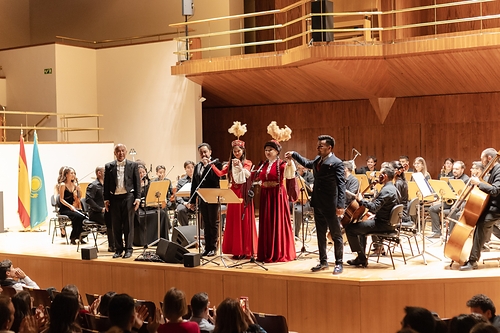
MADRID, Oct. 22, 2026 /PRNewswire/ — On 21 October, the Auditorio Nacional de Música in Madrid hosted Shamshi Alemi, a concert celebrating renowned Kazakh composer Shamshi Kaldayakov. His songs were performed in Spanish for the first time, opening a concert series across Madrid, Paris, and New York under the international cultural project “Shamshi 100.”
Photo Credit: Bulat Utemuratov Foundation
Organised by the Shamshi Alemi Public Foundation with the support of the Bulat Utemuratov Foundation, the project marks the upcoming centenary of Kaldayakov’s birth. Its aim is to introduce international audiences to his work, showcase Kazakhstan’s musical heritage, and strengthen cultural ties between countries. The concert was held in celebration of the Republic of Kazakhstan Day, with the support of the Embassy of Kazakhstan in Spain.
The evening welcomed over 350 guests, including Spanish government officials, diplomats, members of the Kazakh diaspora and students. The programme featured Spanish-language versions of the composer’s best-known songs, including Anim sen edin, Ana turaly zhyr, Qaidasyn, Syr suluyi and Baqyt qushagynda, performed by soloists from the Abai Kazakh National Opera and Ballet Theatre with the Madrid Festival Orchestra.
“A concert ahead of the Republic of Kazakhstan Day is a wonderful opportunity to introduce Spanish audiences to Kazakh culture and musical heritage. Performing them in Spanish opens this music to a new audience. I am confident that the Shamshi Alemi concert will help strengthen cultural ties between Kazakhstan and Spain,” said Danat Mussayev, Ambassador of Kazakhstan to Spain.
“Shamshi Kaldayakov’s songs are widely known and loved in Kazakhstan. It was especially rewarding to see how warmly Spanish audiences embraced this music. We thank the Bulat Utemuratov Foundation for helping bring Kaldayakov’s legacy to international audiences,” said Mukhtar Kaldayakov, the composer’s son and head of the Shamshi Alemi Public Foundation.
As part of the project, 20 songs have been adapted into Spanish, French and English. The tour continues in Paris on 24 October and New York on 28 October.
“It is an honour to introduce international audiences to the King of the Kazakh Waltz. Sharing Kazakhstan’s cultural heritage internationally remains an important priority for us,” said Ainur Karbozova, CEO of the Bulat Utemuratov Foundation.
The Bulat Utemuratov Foundation, established in 2014, has allocated over US$250 million across healthcare, education, culture, environment and regional development in Kazakhstan.
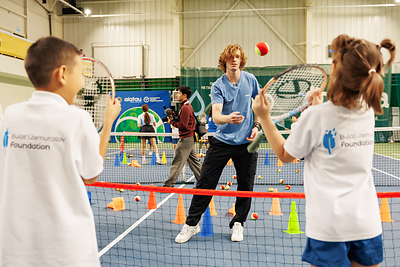
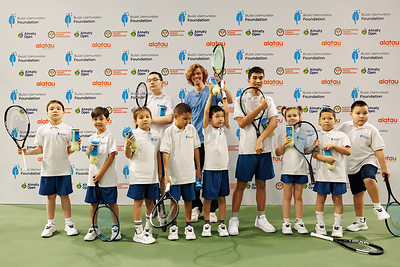
ALMATY, Kazakhstan, Oct. 20, 2026 /PRNewswire/ — World tennis star Andrey Rublev met with ten children from the Asyl Miras Autism Center during the Almaty Open ATP 250 tournament. The initiative, organised by the Kazakhstan Tennis Federation (KTF), continues a longstanding tradition of bringing professional players together with children from Asyl Miras center. The Bulat Utemuratov Foundation runs 13 autism centers across 12 cities in Kazakhstan, providing free, comprehensive support to children with autism spectrum disorder (ASD).
Photo Credit: Bulat Utemuratov Foundation
Photo Credit: Bulat Utemuratov Foundation
“It is particularly important to us that children with ASD have the opportunity to participate in all aspects of life, including sports. Meetings like these help broaden the understanding of inclusion not only among children but also throughout society. Spending time with professional athletes is a meaningful experience for the children and another step toward creating a more open and inclusive environment,” said Ainur Karbozova, CEO of the Bulat Utemuratov Foundation.
On the court, Rublev and children took part in adapted ball-and-racket exercises, accuracy drills, and other activities designed by specialists from Asyl Miras and the KTF to ensure every child could discover tennis in a relaxed and engaging way. The event gave the children a chance to experience something new and take part in a shared sporting activity, while allowing Rublev to learn more about autism and how to interact with children with ASD.
“It was a great experience. First of all, it’s always a pleasure to spend time with children. They teach you so much, and there’s always something special about being part of that playful atmosphere. My mother is also a tennis coach, so I’ve been on the court since I was very young and grew up watching how coaches work with young children. Every charitable initiative is incredibly meaningful, and everyone connects with it in their own way. But the most important thing is simply to do something good,” said Andrey Rublev.
Professional tennis players have supported the Bulat Utemuratov Foundation’s initiatives on numerous occasions. Over the years, Asyl Miras Autism Centers have welcomed Novak Djokovic, Elena Rybakina, Carlos Alcaraz, Felix Auger-Aliassime, Alexander Bublik and many others. Continuing this tradition, Rublev presented the children with tennis rackets after the event so they could continue playing tennis and putting their newly acquired skills into practice.
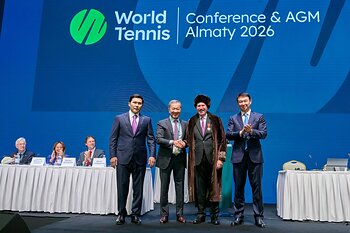
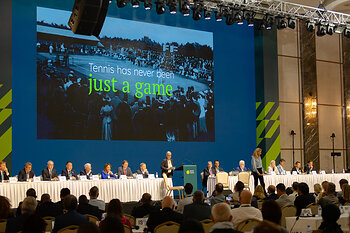
ALMATY, Kazakhstan, Oct. 15, 2026 /PRNewswire/ — Kazakhstan is proud to have hosted the annual World Tennis General Assembly in Almaty from 10 to 13 October. Held in Central Asia for the first time, the event brought together leaders and representatives of national federations, international and continental tennis organisations, industry experts and partners.
Photo Credit: Kazakhstan Tennis Federation
Meetings of the World Tennis Board of Directors were held on 10-11 October. More than 262 delegates from 137 countries participated in panel sessions and voting proceedings from 11 to 13 October.
Photo Credit: Kazakhstan Tennis Federation
The ceremony began with the address from the President of Kazakhstan, Kassym-Jomart Tokayev, to the participants of the General Assembly. The presidential address was delivered by the Mayor of Almaty, Darkhan Satybaldy, who also officially opened the Assembly.
Photo Credit: Kazakhstan Tennis Federation
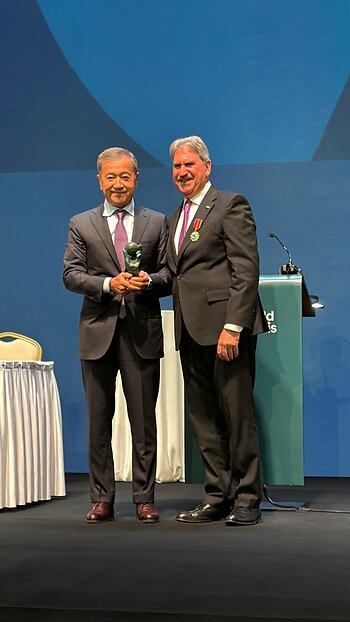
World Tennis President David Haggerty was awarded Kazakhstan’s Order of Dostyk, Second Degree. The award was presented by Kazakhstan’s Minister of Tourism and Sports, Yerbol Myrzabossynov, on behalf of the President of the Republic of Kazakhstan in recognition of Haggerty’s longstanding contribution to the development of tennis and the strengthening of international cooperation through sport.
Hosting the assembly in Almaty reflects the international tennis community’s strong confidence in Kazakhstan and the growing standing of the Kazakhstan Tennis Federation, led by World Tennis Vice President Bulat Utemuratov.
For Almaty, the forum offered an opportunity to showcase the city’s sports infrastructure and tennis traditions to representatives from 137 countries. The assembly facilitates the exchange of expertise, direct dialogue between federation leaders and the development of new international partnerships.
During the General Assembly, World Tennis President David Haggerty presented Bulat Utemuratov, President of the Kazakhstan Tennis Federation, with the Award for Services to the Game. The award recognises outstanding, long-standing contributions to the development and promotion of tennis internationally. This recognition reflects Bulat Utemuratov’s many years of work in developing tennis in Kazakhstan, building modern sports infrastructure, supporting young talent and strengthening the country’s position in the global tennis community.
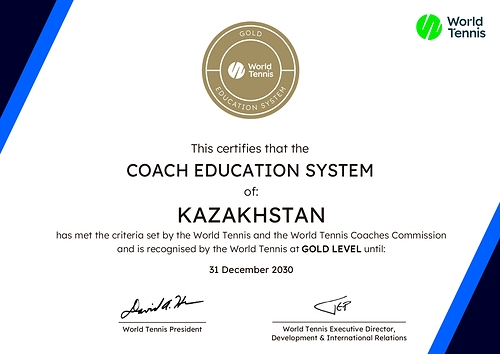
This award came alongside Kazakhstan’s coach education system being recognised at Gold level an outstanding recognition of the country’s coaching programmes.
The centrepiece of the programme was the World Tennis General Assembly meeting on 13 October.
The General Assembly is a major forum for discussing the development of tennis worldwide. Participants addressed ways to make the sport more accessible, develop junior tennis, improve sports infrastructure, train coaches and officials, and organise international competitions.
Particular attention was given to supporting national federations and strengthening international cooperation. Delegates reviewed progress, discussed strategic initiatives and identified priorities that will guide the development of tennis across countries and regions.
“Hosting this crucial assembly shows the vital role Kazakhstan is playing in global tennis and is a testament to the hard work of everyone at the Kazakhstan Tennis Federation. It was a pleasure to host my fellow representatives and work on the issues that will shape the future of tennis across the globe” said Bulat Utemuratov President of the Kazakhstan Tennis Federation and Vice President of the International Tennis Federation.
ASTANA, Kazakhstan, Oct. 14, 2026 /PRNewswire/ — World Tennis has officially recognised the Kazakhstan Tennis Federation’s coach education system at Gold level. The recognition confirms that the system meets international quality standards and is valid until 31 December 2030.
The decision follows a comprehensive review of the documentation submitted by the Federation. Kazakhstan’s coach education system has met all the criteria established by World Tennis and its Coaches Commission for Gold-level recognition.
Photo Credit: Kazakhstan Tennis Federation
Gold status confirms that the Federation can independently provide coach education and certification up to High Performance level, equipping coaches to work with high-level athletes. This recognition demonstrates that the education system meets international requirements for training quality and professional coaching competencies.
In an official letter dated 9 October 2026 and addressed to Kazakhstan Tennis Federation President Bulat Utemuratov, World Tennis Executive Director for International Relations and Development Erik Poel congratulated the Federation on achieving Gold status.
The recognition also grants the Federation the right to use the World Tennis logo on its coach education materials and resources, including coach licence cards.
Achieving Gold-level recognition marks an important outcome of the Federation’s sustained work to develop coach education. Training qualified professionals provides a foundation for improving the quality of coaching, developing children’s and junior tennis, and supporting the continued progress of Kazakhstani players.
Bulat Utemuratov, President of the Kazakhstan Tennis Federation said:“I’m incredibly proud that the Federation has achieved this recognition. We’ve invested significantly in our coaching programmes and it is great to see the results of that.
“We have brilliant coaches across Kazakhstan and this recognition will further support their work as we look to develop the next generation of talent. I’d like to personally thank everyone involved for their hard work.
“We’ve seen our current stars achieve amazing feats recently and this recognition and our outstanding coaching system will allow this to continue.”
ASTANA, Kazakhstan, Oct. 1, 2026 /PRNewswire/ — The Ministry of Artificial Intelligence and Digital Development of the Republic of Kazakhstan, Beeline Kazakhstan, in partnership with Starlink Mobile, is launching satellite mobile connectivity based on Direct to Cell technology. The technology will allow users to access selected communication services on compatible smartphones beyond the coverage of terrestrial mobile networks.
The introduction of Starlink Mobile is the result of agreements reached during President Kassym-Jomart Tokayev’s official visit to the United States in 2025.
Photo Credit: Beeline Kazakhstan
“In autumn 2025, during President Kassym-Jomart Tokayev’s official visit to the United States, Kazakhstan reached an agreement on the introduction of Starlink Mobile (Direct to Cell) satellite connectivity. Today, we are seeing this agreement become a reality. Kazakhstan has become the first country in Central Asia where Direct to Cell has undergone practical testing and is now moving to the user service stage,”said Zhaslan Madiyev, Deputy Prime Minister and Minister of Artificial Intelligence and Digital Development of the Republic of Kazakhstan.
The technology provides a direct connection between a compatible smartphone and Starlink Mobile satellites without the need for a dedicated satellite phone, external antenna or additional equipment. Users will be able to send and receive messages, as well as access to select apps in areas without terrestrial mobile network coverage. For Beeline Kazakhstan customers, the service will be available free of charge during the promotional period.
For Kazakhstan, with its vast territory, satellite mobile connectivity is of particular importance, creating additional opportunities for communication from hard-to-reach areas and where terrestrial infrastructure has been damaged.
“Beeline has been operating in Kazakhstan for more than twenty years, and throughout this time we have consistently invested in the development of connectivity and new technologies. Kazakhstan is one of the largest countries in the world by territory, and distance should not become a barrier to people’s access to modern technologies. The development of digital infrastructure is a long-term investment in the country’s competitiveness and quality of life and we are proud to be able to support this crucial infrastructure development,”said Kazakhstani businessman and investor of the Verny Capital Group, Bulat Utemuratov.