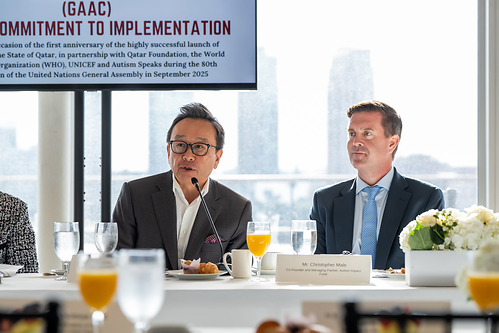
NEW YORK, Sept. 29, 2026 /PRNewswire/ — The Bulat Utemuratov Foundation will become a regional partner of the Global Autism Advocacy Coalition (GAAC) and will establish a hub for the countries of Central Asia and the South Caucasus. The new platform will bring together the expertise of international and regional organizations to develop systemic support for people with autism spectrum disorder (ASD).
Photo Credit: Bulat Utemuratov Foundation
The hub’s primary objective will be to adapt and implement international practices in line with the specific characteristics of the countries in the region. It will unite specialists, relevant organizations, and government representatives to facilitate the exchange of expertise, and promote broader access to evidence-based approaches, research, and data.
GAAC was established in 2025 at the United Nations headquarters in New York with the participation of Qatar Foundation, Autism Speaks, the World Health Organization, and UNICEF. The Bulat Utemuratov Foundation was a founding member of the Coalition. The creation of the regional hub marks the next stage of the Foundation’s cooperation with GAAC and will enable the further advancement of the Coalition’s initiatives.
The regional GAAC model for Central Asia and the South Caucasus was presented by Almaz Sharman, Chairman of the Board of Trustees of the Bulat Utemuratov Foundation, in New York in September 2026, during the UN General Assembly.
“For the sustainable development of support systems for people with autism, it is not enough to have proven solutions – it is equally important to create the conditions for their adaptation and implementation in accordance with national and regional contexts,” said Almaz Sharman.
The foundation for this work will be the Bulat Utemuratov Foundation’s many years of experience implementing the ‘Autism. One World for All’ program under which 13 Asyl Miras autism centers operate across 12 cities in Kazakhstan, supporting more than 17,500 children with ASD. The program encompasses the development of diagnostics and early intervention, specialist training, and the introduction of new support models.
“In recent years, Kazakhstan has accumulated significant practical experience in supporting children with autism and their families, in large part thanks to the specialists at the Asyl Miras autism centers. It is important to us that the knowledge gained in Kazakhstan becomes part of the international dialogue,” said Ainur Karbozova, CEO, Bulat Utemuratov Foundation.
The President congratulated Elena Rybakina on her triumph at the US Open and her achievement of the world number one ranking, noting the historic significance of this success and her invaluable contribution to the development of sport in Kazakhstan.
“Following your victories, our children are showing an interest in tennis, signing up for training sessions in large numbers, and aspiring to become champions themselves. You set a positive example for our children, and that is excellent. It is crucial for our children’s future that they engage in sports. Three Grand Slam victories will forever remain in the annals of tennis history. I believe you will not stop here and will continue your winning streak,” the Head of State said.
He also highlighted Elena Rybakina’s distinctive human qualities.
“You behave admirably both on the court and in your interactions with others. I always note your exceptionally high personal culture. This is of great importance, not least in terms of presenting Kazakhstan as a developed and civilized nation that supports sports, and tennis in particular,” Kassym-Jomart Tokayev emphasized.
In turn, Elena Rybakina expressed her sincere gratitude to Kassym-Jomart Tokayev for his personal support and for the special attention that he devotes to the development of tennis in Kazakhstan.
The world number one stated that she was very proud to represent Kazakhstan on the international stage. She intends to continue achieving great results and delighting domestic fans with her victories.
Kassym-Jomart Tokayev awarded Elena Rybakina the Order of Barys, 3rd Class, for outstanding sporting achievements and a significant contribution to the development and popularization of tennis in Kazakhstan.
The Bulat Utemuratov Foundation will provide financial assistance to the families of the military servicemen who died during Naval exercises on the Caspian Sea coast in the Mangystau Oblast.
A sum of 25 million tenge will be allocated to the family of each deceased serviceman. This aid will be provided directly to the families, in addition to the state support measures already in place for the bereaved.
Bulat Utemuratov expressed his deepest condolences to the family members and close ones of the fallen servicemen.
The tragedy occurred on 24 September during a combat training exercise. Following the deaths of the servicemen, a national day of mourning was declared in Kazakhstan for 25 September.
Kazakhstani tennis experienced a remarkable September. Elena Rybakina became the first player in the country’s history to top the WTA rankings, and just days later in Astana, the men’s national team staged its own tennis drama on the courts of the Beeline Arena National Tennis Centre.
After the first day of play, things seemed to be going quite smoothly for Kazakhstan, with two singles victories giving them a 2–0 lead. However, that is what sets the Davis Cup apart from a standard tournament: winning a single match isn’t enough: the team has to go the entire distance. And, sometimes, a gained advantage can vanish just in a matter of hours.
That is exactly what happened in Astana. Thailand clawed back two points to level the tie, meaning the outcome would be decided in the fifth match. Timofey Skatov took to the court once again, fighting to keep his team’s right to continue in the Davis Cup World Group I.
Alexander Shevchenko was the first to step onto the court for Kazakhstan. His opponent was Maximus Parapol Jones, a player ranked significantly lower than the Kazakhstani: heading into the match, Shevchenko was ranked 93rd in the world, while Jones was 463rd. However, the opening rallies immediately demonstrated that a gap in rankings does not equate to a difference in fighting spirit. Shevchenko took the first set 6–4. In the second, Jones unexpectedly seized the initiative and responded winning the set 6–1. Everything had to be decided in the third set. It proved to be a classic Davis Cup encounter: tense and tightly contested, with the outcome uncertain until the very last moment. Shevchenko ultimately clinched the deciding set 7–5, after a match lasting two hours and three minutes.
The first point was secured. Yet, it likely became clear even then that Kazakhstan would not have an easy ride. Timofey Skatov took the court next, facing Kasidit Samrej. Skatov managed to avoid a third set in this match; he won the first set 6–4 and took the second to a tie-break (7–4). Thus, Kazakhstan finished the first day of play with a 2–0 lead. They needed to win just one more match out of the remaining three. On paper, it looked like a comfortable position. But sport rarely follows a script written on paper—especially in tournaments like the Davis Cup.
The morning of the second day of play began with a doubles match. Beibit Zhukayev and Denis Yevseyev lost to Pruchya Isaro and Maximus Jones 4–6, 6–3, 5–7. Thailand narrowed the deficit to 1–2. This defeat shifted the atmosphere of the tie; Kazakhstan now needed to win at least one of the two remaining singles matches.
Shevchenko was the first to have a chance to close the match. Indeed, the start of his encounter with Samrej was once again going in Kazakhstan’s favor; Alexander took the first set 6–1. It seemed that just one more set would seal the victory. However, Samrej had already demonstrated in his opening match that he had no intention of rolling over. The Thai player adjusted his game, played with greater confidence during rallies, and won the second set 6–2. He maintained the initiative in the third set and ultimately won the match: 1–6, 6–2, 6–3. The score was now tied at 2–2. And now, everything was starting all over again.
The deciding match featured the same two players who had effectively kicked off the tie: Timofey Skatov and Maximus Jones faced off against each other. For Jones, it was his second match of the day, while for Skatov, it was a decisive encounter on home soil. Skatov started confidently, securing an early break of serve. Kazakhstani took the first set 6–4, but Jones showed no signs of simply accepting defeat. In the second set, the Thai player managed to hold his ground, and with the score at 5–4, he had a chance to close out the set. Skatov had been leading but committed several errors, ultimately dropping the set 4–6.
Then came the third set – the deciding match that stood between Kazakhstan and victory, and between Thailand and a trip back home with a won tie. In the fifth game, Skatov managed to break Jones’s serve, albeit with some difficulty. He then consolidated the break to take a 4–2 lead. From there, he couldn’t afford to let his opponent back. Skatov withstood everything his opponent threw at him, winning 6–4, 4–6, 6–4. Kazakhstan won the tie 3–2.
After the match, Skatov spoke not so much about a brilliant victory as about relief.
“I feel relieved and happy now that we ultimately won. It was a very tough match. All the matches were tense; four of them went to three sets. It was very nerve-wracking.”
The encounter between the two countries was not a story where one team convincingly outplayed the other. On the contrary, Kazakhstan took a 2–0 lead, then let it slip away, and subsequently had to summon the strength for a decisive showdown. Moreover, Skatov found himself in a scenario tailor-made for a sports drama: playing the deciding match to secure a spot in World Group I.
At first glance, tennis can be broken down into statistics: rankings, scores, first-serve percentages, break points and sets won. Yet, as Alexander Shevchenko noted, there is a unique story behind every number, and it is always difficult to predict the outcome of a clash between players with different rankings.
Shevchenko himself opened the tournament against a significantly lower-ranked opponent but was forced to play three sets to prove his superiority. Skatov defeated Samrej, yet the very next day, Samrej beat Shevchenko. Jones first lost to Shevchenko, then helped Thailand win the doubles match, and – after a very short break – stepped back onto the court to face Skatov. Each time, players from both teams had to readjust. In this sense, tennis is a very honest sport. A previous match doesn’t help you win the next one. Rankings don’t automatically award points. A strong start to a set doesn’t guarantee winning it. And a 2–0 lead doesn’t mean the match is over.
The men’s tennis team experienced a rollercoaster of emotions over two days: confidence after the first day of play, tension following the doubles loss, a shocking turn of events in the Shevchenko-Samrej match, and, finally, the deciding duel. Kazakhstan didn’t secure this victory easily; they had to fight hard to claw it back. Timofey Skatov was the one who did it. His deciding match served as the final act of a two-day showdown that saw hardly any easy moments: four of the five matches went to three sets.
Looking at Kazakhstani tennis from a broader perspective, it is symbolic that this story unfolded right now. Just a few days ago, Elena Rybakina became the world number one, the first representative of Kazakhstan in history to top the global singles rankings. Then, in Astana, the men’s national team passed its own test of mettle, securing a spot in the Davis Cup World Group I playoffs.
In the final match, she competed with Belarusian Aryna Sabalenka.
Kazakhstan’s top-ranked female singles player, Elena Rybakina, has won the 2026 US Open title. The Kazakhstan Tennis Federation announced the news.
In the US Open final, the Kazakhstani athlete faced Belarusian Aryna Sabalenka. The match went to three sets, with Rybakina gaining victory with a score of 6–4, 5–7, 6–2.
For Elena Rybakina, this was her first US Open title and her third Grand Slam singles trophy. The Kazakhstani tennis player claimed her debut Grand Slam victory at Wimbledon in 2022. Earlier in 2026, she won the Australian Open, and she has now added the US Open title to her collection.
Bulat Utemuratov, President of the Kazakhstan Tennis Federation, congratulated the athlete on this historic achievement.
“This is a tremendous victory for Elena and a historic day for tennis in Kazakhstan. I thank Elena for once again giving her all in the contest and demonstrating a world-class level of play on one of the globe’s biggest tennis stages. Elena continues to be a shining example of the successful development of tennis in our country, and her ascent to the very pinnacle of the sport will serve as a powerful source of inspiration for the young generation of Kazakhstani players, whom we will continue to support in every way,” noted Bulat Utemuratov.
The victory in New York marks another historic milestone in Elena Rybakina’s successful season. It was previously reported that the Kazakhstani tennis player is set to reach the number one spot in the WTA world rankings for the first time in her career.
Elena Rybakina now holds two of the four Grand Slam titles in women’s tennis. Charly Triballeau / AFP via Getty Images
By Matthew Futterman
Sept. 12, 2026
NEW YORK — A year ago, Elena Rybakina was on the outside looking in.
She couldn’t get past the fourth round of any of the Grand Slams. She was questionable to make the WTA Tour Finals in Riyadh, Saudi Arabia. She had to play a grueling series of tournaments in September and October just to squeak into the season-ending championship.
Then, she won it. In the final, she handcuffed Aryna Sabalenka, using the laser serve, sweeping forehand and whip-crack backhand that she can windmill with her eyes closed. She left with a trophy and more than $5 million, at the time the biggest payday in the history of women’s tennis.
Less than a year later, she did it all over again Saturday in Arthur Ashe Stadium. Again, she manacled Sabalenka. Again, she picked up a record-setting check, this time for $5.5 million. What’s new? She also collected the world No. 1 ranking, overtaking Sabalenka with a run that has also made her reigning champion at two of the four Grand Slams.
For Rybakina, a 27-year-old native of Russia who has represented Kazakhstan for the past nine years, her 10-month surge is a microcosm of her remarkable backstory and career.
When Rybakina was in her late teens, the Russian tennis federation essentially gave up on her. It’s a huge country. Other promising juniors were more worthy of investment and coaching, in the federation’s view. Rybakina’s parents could not afford to finance the training and travel necessary for a fledgling professional tennis career.
The new tennis queen – with a fascinating backstory
On the verge of heading to the United States for college, Rybakina found another way.
In 2007, Bulat Utemuratov, a billionaire industrialist from Kazakhstan and avid tennis fan, embarked on a spending spree to build a national development system from scratch. Infrastructure was the easy part. That doesn’t make talent. Utemuratov looked to talented players from more established countries who were swimming upstream.
One was Alexander Bublik. Rybakina was another. Kazakhstan’s tennis federation funded all the training and travel that Russia’s federation wouldn’t and Rybakina’s parents couldn’t. In exchange, Rybakina represented Kazakhstan, serving as a role model for young athletes in a country that had little tennis culture and little history of tennis success.
Four years later, Rybakina won the 2022 Wimbledon championship. That triumph was also textured by her developmental journey. Had Rybakina not switched her nationality, she would have been prohibited from competing in that edition of the tournament. The All England Lawn Tennis Club had prohibited players from Russia and Belarus from participating in the event as punishment for Russia’s invasion of Ukraine, which Belarus supported.
Instead, Rybakina played. She won. An ascension had begun.
Elena Rybakina won the 2022 Wimbledon championship with Bulat Utemuratov in attendance.Julian Finney / Getty Images
By the end of last summer, Rybakina’s trajectory appeared to have reversed. In September 2024, she fired her coach, Stefano Vukov, but then brought him back. Ahead of the 2025 Australian Open, Vukov was provisionally suspended by the WTA Tour during a code of conduct investigation.
Vukov denied the breach. Rybakina, then-ranked No. 6 in the world, had repeatedly stated that Vukov’s conduct toward her had never been abusive.
August became September. Rybakina lost in New York. She went on her gauntlet run to qualify for the WTA Tour Finals. She won it, declining a photo with Archer during the trophy ceremony.
Then she started this year by winning the Australian Open, defeating Sabalenka in the final. By the time the tournament had ended, Rybakina had won 20 of her past 22 matches, going 10-0 against top-10 opponents.
Seven months on, she has another major title, surprising no one more than herself, given that she injured her left leg last month and could barely walk as she retired from the Cincinnati Open quarterfinals.
“I cannot find the words,” she said on the court during the trophy ceremony Saturday. “I didn’t expect anything like this coming into the tournament.”
As Rybakina spoke, Utemuratov was receiving congratulations in one of the luxury suites inside Arthur Ashe Stadium.
On Friday, in the hours after Rybakina had defeated Coco Gauff to make her first U.S. Open final, Utemuratov had boarded his Gulfstream jet in Almaty, Kazakhstan, and flown 14 hours straight to New York.
“People love her a lot in Kazakhstan,” Utemuratov said during an interview an hour before the final began. “Not only her tennis, but also her personality, her smile, her calm. She’s humble, intelligent.”
As he spoke, Utemuratov flipped through a series of photos of billboards and other images of Rybakina all over Almaty: At the airport; on a scoreboard in a soccer stadium; along the streets of the city. The U.S. Open final was set to start at 2 a.m. local time in Kazakhstan.
“They won’t go to sleep,” Utemuratov said.
He showed a video of children at tennis centers all over the country — many of them financed in part by his largesse — sending their congratulations and conveying their love for a player who only became their compatriot through a confluence of bad decision-making by the Russian federation and the good fortune of being a solution to someone else’s problem.
“We met and talked and discussed a partnership,” he said. They provided the resources for success. She set the course, trying to find the right people to surround herself with, and then she went to work.
“We saw from the beginning that she was super professional,” he said.
Elena Rybakina served her way to the U.S. Open title in New York, protecting it on an off-day in the final. Caleb Bowlin / Getty Images
It has hardly been the smoothest ride. The firing, rehiring and investigation of Vukov coincided with a drop in her performance and difficulties with sleep and health. After she fired Vukov, Rybakina hired Goran Ivanišević, the 2001 Wimbledon champion and former coach of Novak Djokovic. Ivanišević quit in early 2025, when Rybakina announced that Vukov would rejoin her team, describing her time with Ivanišević as a “trial period.”
Rybakina lives in Dubai. Much of her family remains in Russia. But each year, Utemuratov said, either before or after the fall swing of hard-court tournaments in China, Japan and South Korea, Rybakina visits Kazakhstan, where she has two charities. One funds young and gifted tennis players; another supports less advantaged people.
It’s not the typical existence, but Rybakina has repeatedly found a way to make it work.
“No year is ever the same,” she said in a news conference. “It’s an amazing journey, and hopefully I can continue to stay at the top.”
Three weeks ago, just getting to the top seemed impossible. After a shellacking from Iga Świątek in the Canadian Open final, Rybakina pulled out of the Cincinnati Open quarterfinal against the same opponent with pain in her Achilles tendon.
Playing in New York seemed unlikely. She didn’t touch a racket for more than a week. Then she started again by winning in the first round and never stopped.
“Every day was kind of a challenge, but I felt like in these situations I was more calm than when similar things were happening before,” she said.
Some 6,400 miles away in Kazakhstan, Utemuratov was keeping tabs on her.
In her last comments Saturday evening, standing on Arthur Ashe Stadium with the trophy and the top ranking hers, Rybakina had a message for her adopted home.
“A big thank you for all the support and belief,” she said. “I am planning to come and want to share this moment.”
Bulat Utemuratov, the man behind the project to bring Elena Rybakina to Kazakhstan: “Her status as world number one confirms the wisdom of our investments and efforts.”
Born in Moscow but having switched her citizenship to Kazakhstani in 2018, Elena Rybakina will forever write her name into the history of her new homeland by becoming the first-ever world number one from this Central Asian country. This marks the realization of a project launched by Federation President Bulat Utemuratov, who believes this symbolic achievement will inspire future generations.
Louis Boulet Published on September 10, 2026, at 18:06
The top spot was within reach, and now it is official: thanks to her US Open quarterfinal victory over Zheng Qinwen on Wednesday (3-6, 6-1, 6-4), Elena Rybakina has secured her place as the next world number one on Monday. Since the WTA rankings were established in November 1975, twenty-nine queens of the tour have held the throne, and for the first time, a representative of Kazakhstan will add her name to this prestigious list.
Born in Moscow, Rybakina switched to fly the flag of this Central Asian country in 2018 as part of a sporting and financial project launched by Bulat Utemuratov, the influential president of the Kazakhstan Tennis Federation. He invested heavily in young Russian players (such as Rybakina, Alexander Bublik and many others) to put Kazakhstan on the global tennis map. That gamble paid off, and Utemuratov hopes this success will only continue to grow.
“How did you experience the US Open quarterfinal match that Elena Rybakina won, securing her status as world number one?
— It was an exceptional victory for Elena and a historic day for Kazakhstani tennis. I can only thank her once again for giving it her all and displaying a world-class level of play on one of the sport’s biggest stages. By reaching the US Open semifinals again and officially clinching the top spot in the world rankings, she has clearly demonstrated her progress and consistently high quality of play. She arrived in New York fresh off a recent injury, yet her resilience and mental strength were remarkable. She continues to perfectly embody the successful development of tennis in our country, and her ascent to the very pinnacle of world tennis will deeply inspire the young generation of Kazakhstani tennis players whom we will continue to support with every means at our disposal.
“The Federation was ready to provide her with all the necessary support she needed, and Elena, in turn, made rapid progress, delivering numerous historic victories for Kazakhstan.”
Bulat Utemuratov on Elena Rybakina’s change of citizenship:
Her rise to the top of the world rankings represents a historic achievement for Kazakhstani tennis…
It is a moment of immense pride and joy for all of us at the Federation, as well as for the entire country. Seeing an athlete representing Kazakhstan reach the pinnacle of world tennis is the realization of a dream we have long cherished. It validates our strategic investments and the tireless efforts we have dedicated to developing the sport over the years. Elena perfectly embodies the successful growth of tennis in our country, and we are incredibly happy for her and for what this means for our community.
You decided to support Rybakina when she was 19, long before she was considered a potential world number one. How did her journey unfold, and how did the Federation support her?
— When Elena first approached us, we immediately recognized her tremendous talent and potential. Even then, we knew that, with the right guidance, she could reach the pinnacle of the sport. However, the most important factor in our decision was the combination of her excellent discipline and iron determination. Her exceptional personal qualities allowed us to build a relationship based on deep trust and a genuine bond. The Federation was ready to provide all the necessary support, and Elena, in turn, progressed rapidly, delivering numerous historic victories for Kazakhstan. It has been an amazing journey built on mutual trust.
What impresses you most about her progress?
— Beyond her obvious physical attributes, I am incredibly proud of her character and mental strength. Reaching the world number one spot requires exceptional resilience. Despite all her success, Elena has remained humble, focused and true to her values. I am proud of the elegance with which she represents Kazakhstan on the global stage.
What will this world number one ranking mean for the Federation and the continued growth of tennis in Kazakhstan?
— This historic achievement is incredibly important to us, as it is the result of years of hard work by the entire Federation, and I am grateful to everyone involved. However, its greatest value lies in the impact it will have on the future. Elena’s example will serve as a powerful source of motivation and confidence for thousands of children and their parents across Kazakhstan. Seeing one of our own reach the absolute top of the sport proves that even the most ambitious goals are attainable. This inspiration is invaluable, and it will undoubtedly help us nurture new generations of tennis players and future champions.
The Bulat Utemuratov Foundation unveiled the deployment of 460 million tenge, (around USD 1 million) towards the gasification of residential private properties in Almaty. Undertaken in collaboration with the Akimat of the city of Almaty (Office of the Mayor), the joint venture seeks to upgrade city infrastructure, elevate residential living standards, and boost air quality across the city.
Photo Credit: Bulat Utemuratov Foundation
The Akimat of the city of Almaty, has agreed to examine private properties, liaise with occupants on the connection process and deliver thorough guidance around the shift to natural gas heating. The required building and system installation work will then be handled by certified contractors.
Darkhan Satybaldy, Akim (Mayor) of Almaty, emphasized: “We continue targeted work to connect private homes to the city’s gas supply network. The requirements may vary in each case, which is why it is important to comprehensively support residents, from consultations to the actual connection, alongside technical work. The support of socially responsible businesses allows us to broaden this initiative.”
Throughout colder months, private residences using carbon-heavy fuels for heating are considerable contributors to air pollution. Moving these homes away from coal to natural gas is a key component in strengthening the air quality of Almaty.
Ainur Karbozova, CEO of theBulat Utemuratov Foundation, noted: “It is important for us to support a project aimed at developing urban infrastructure and creating more comfortable conditions for the residents of Almaty. The gasification of the private sector will enable families who are not yet connected to the gas supply system to transition to a modern heating method. We are delighted to support this city initiative.”
This gasification project further represents the Foundation’s enduring support for Almaty. Prior to this initiative, the Foundation enabled the upgrade of ventilation and air conditioning infrastructure at the National Central Museum of the Republic of Kazakhstan, an extensive redevelopment of the Botanical Garden and the inauguration of one of the first Asyl Miras Autism Centers. As well as these projects, the Foundation reinforced the local healthcare sector during the COVID-19 pandemic, through the delivery of mobile laboratories designed to carry out PCR testing.
ALMATY, Kazakhstan, Sept. 3, 2026 /PRNewswire/ — Narxoz Business School has officially received joint accreditation from the Association of MBAs (AMBA) and the Business Graduates Association (BGA), cementing its position among the world’s leading business schools. This dual recognition places Narxoz in the top 2% of global business education providers, alongside elite institutions such as INSEAD, London Business School, and HEC Paris.
Photo Credit: Narxoz University
Awarded following a rigorous evaluation by international academic leaders, the accreditation recognizes Narxoz’s commitment to high standards, innovation, and continuous development.
Andrew Main Wilson, CEO of AMBA and BGA, said: “I am delighted that Narxoz Business School has received joint AMBA and BGA accreditation. This recognition reflects the school’s commitment to high standards, innovation, and the continuous development of business education. The commission was impressed by the university’s strong academic heritage, its contribution to Kazakhstan’s overall development, and the leadership’s dedication to creating a world-class educational environment for students, alumni, and the business community.”
For Narxoz University, the milestone validates a multi-year transformation into a modern, globally competitive institution. The evaluating commission specifically highlighted the impact of the school’s International Advisory Board and its newly modernized campus infrastructure.
Kanat Kozhakhmet, President of Narxoz University, commented: “This landmark achievement confirms Narxoz’s unique ability to drive deep transformation and achieve results that meet the highest international standards. It was made possible through the long-term vision and support of our shareholder Bulat Utemuratovalongside the professionalism of our team, faculty, alumni, and partners.”
While AMBA evaluates specific program quality, including teaching standards and employer engagement, BGA assesses broader institutional strategy, culture, and societal impact.
Gulnara Kurenkeyeva, Dean of Narxoz Business School, said: “The true value of these dual accreditations is the continuous quality control. We will regularly update our curriculum, assessment methods, and technology to reflect market shifts and employer feedback, ensuring our training remains directly connected to real-world business challenges.”
Over the past 17 years, Narxoz Business School has trained over 3,000 top managers and entrepreneurs across its MBA, Executive MBA, DBA, and corporate programs. As a result of this accreditation, students and alumni will now receive complimentary lifetime membership in the global AMBA community, granting them access to a powerful network of 80,000 professionals across 150 countries.